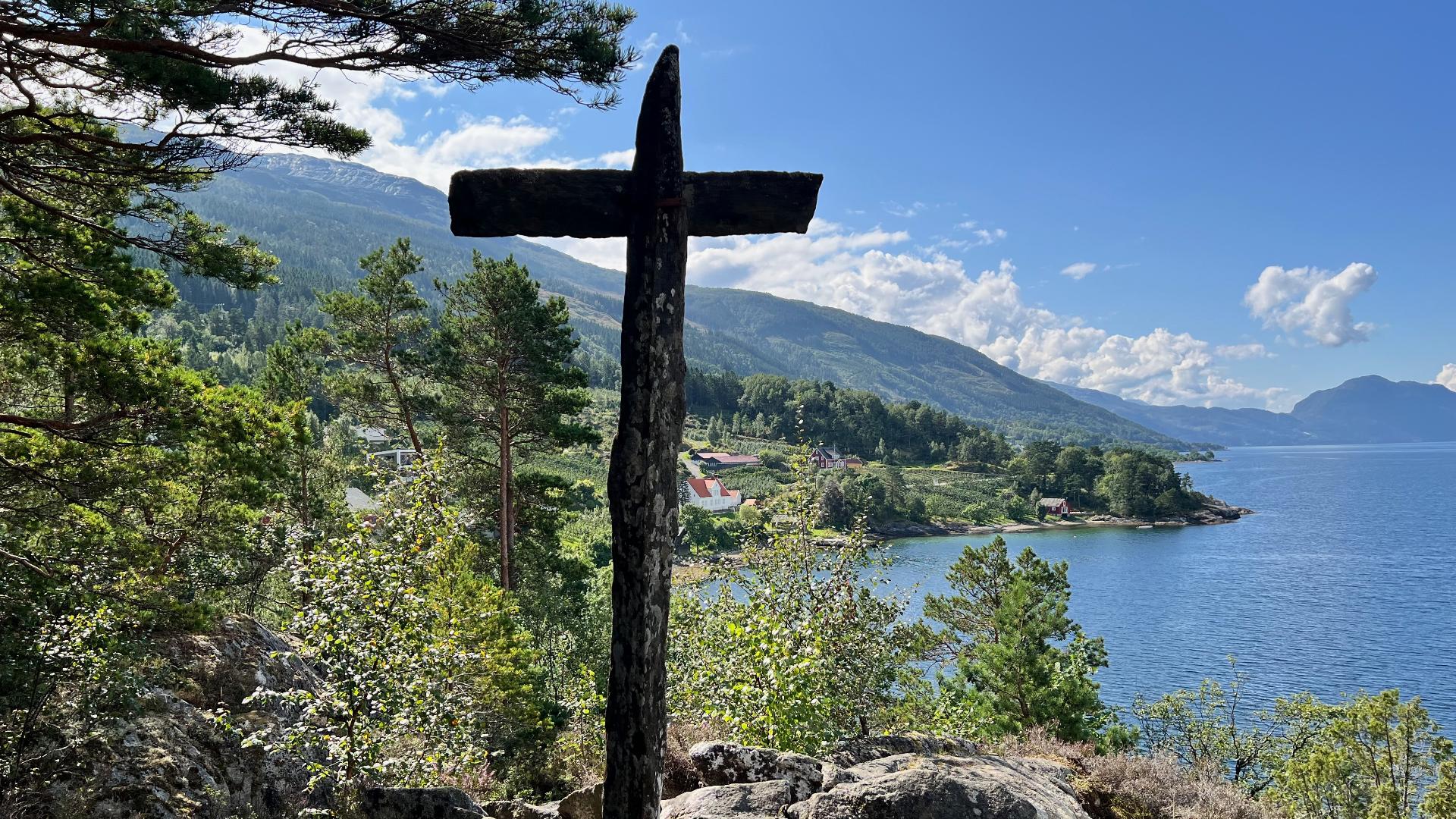
Steinkrossen at Hesthamar is a 4.5-metre stone cross dating from around 1303, one of the oldest preserved cultural monuments in Hardanger. It was erected to commemorate Sigurd Brynjulvsson Aga, a lawman, royal councillor, and knight whose body washed ashore here at the meeting point of the Samlafjorden and Sørfjorden. He had drowned during a sea crossing, though persistent rumour says he was found headless, suggesting murder rather than accident.
The timing makes that plausible. Sigurd had served on the council of King Eirik II Magnusson, who died in 1299 at thirty. His successor Håkon V had a troubled relationship with his brother's confidants. In December 1302, he had Baron Audun Hugleiksson hanged in Bergen. Whether Sigurd fell victim to the same power struggle or simply to the storms on the Samlafjorden, we will probably never know.
The cross originally had a Maltese soapstone cross on top, a symbol of Christian knights, but it was broken off in the 1800s when a youngster climbed the stone. Sigurd's marble tombstone, showing him in full knightly armour, was among the finest medieval grave markers in Norway. After the Reformation in 1536, the monks at Opedal were expelled and the tombstone was laid down as a stepping stone in Ullensvang church at Lofthus, where generations of churchgoers wore away its inscriptions. A copy with the full text can be seen at Agatunet, where Sigurd once held court in the Lagmannsstova, Norway's oldest preserved courtroom, dating from 1220.
The timing makes that plausible. Sigurd had served on the council of King Eirik II Magnusson, who died in 1299 at thirty. His successor Håkon V had a troubled relationship with his brother's confidants. In December 1302, he had Baron Audun Hugleiksson hanged in Bergen. Whether Sigurd fell victim to the same power struggle or simply to the storms on the Samlafjorden, we will probably never know.
The cross originally had a Maltese soapstone cross on top, a symbol of Christian knights, but it was broken off in the 1800s when a youngster climbed the stone. Sigurd's marble tombstone, showing him in full knightly armour, was among the finest medieval grave markers in Norway. After the Reformation in 1536, the monks at Opedal were expelled and the tombstone was laid down as a stepping stone in Ullensvang church at Lofthus, where generations of churchgoers wore away its inscriptions. A copy with the full text can be seen at Agatunet, where Sigurd once held court in the Lagmannsstova, Norway's oldest preserved courtroom, dating from 1220.