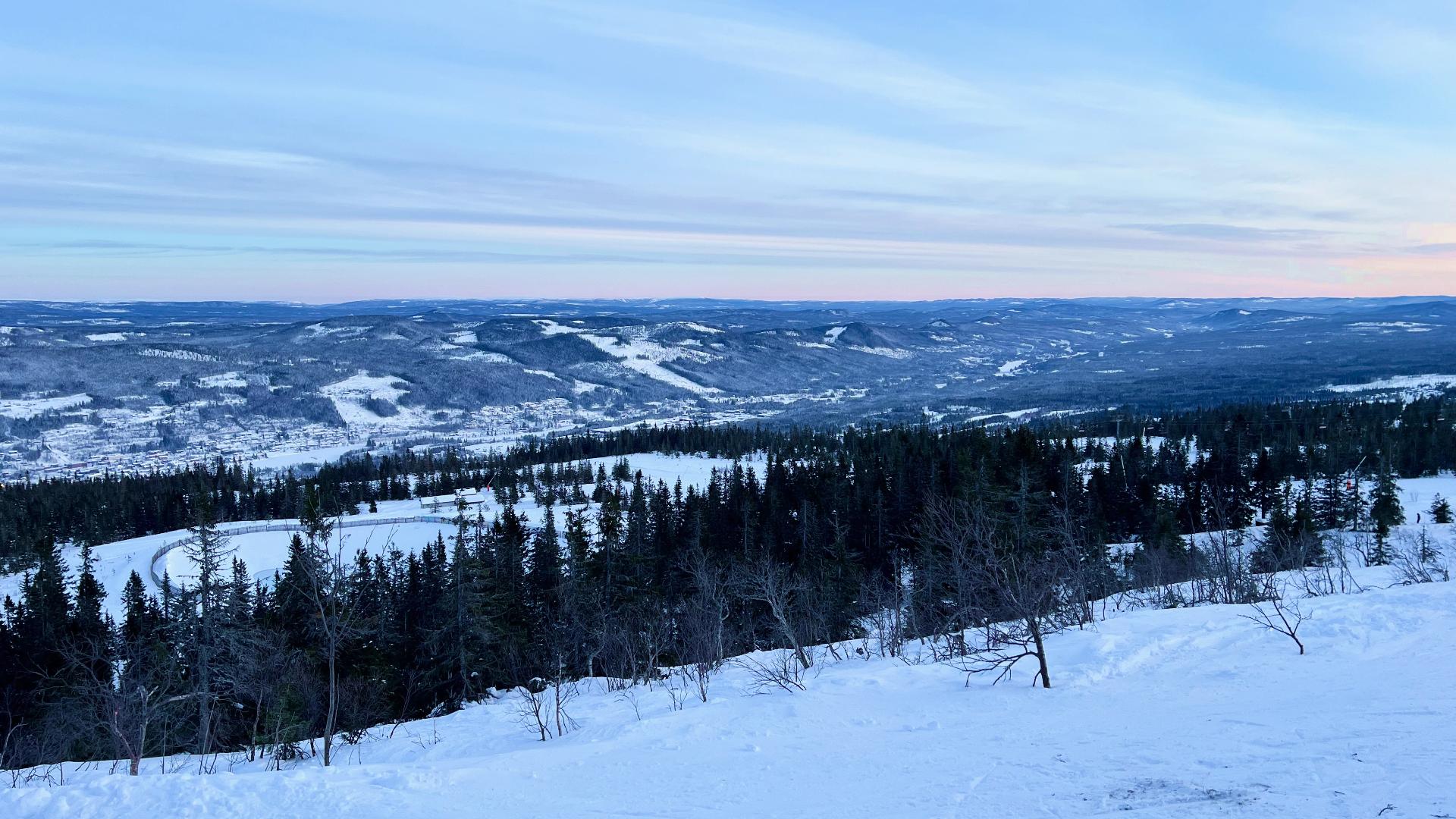
Norway's largest ski resort is not in the mountains. Trysilfjellet rises to 1,132 metres, but it is essentially a lone sandstone hill standing above an ocean of spruce forest. The surrounding terrain sits at 500 to 600 metres. There are no dramatic peaks, no glaciers, no alpine valleys. The bedrock is Precambrian Trysilsandstein, over a billion years old, worn smooth by ice ages into the rounded shape you see today. The prominence is 594 metres, meaning it rises nearly 600 metres above everything around it, but it looks nothing like the Scandinavian mountain chain further west.
That a place like this became the country's biggest ski destination is a story of proximity and persistence. Oslo is three and a half hours away. The first "lift" appeared in 1958: a tractor with a winch on the slope at Håvi. In 1966, a permanent rope tow called Familietrekket opened during the Christmas holidays, and this is counted as the resort's official start. The first proper T-bar at Skihytta came in 1976. The first chairlift, Knetta, was not built until 1989.
In 1985, the two sides of the mountain were connected over the top, allowing a single lift pass for the whole area. Three years later, everything was consolidated into one company, Trysilfjellet AS. Swedish company SkiStar bought the resort in 2005 and invested steadily in lifts, snow-making, and accommodation. In December 2025, the first gondola opened.
Today there are 69 slopes and 41 lifts spread across four base areas: Turistsenteret, Høyfjellssenteret, Høgegga, and Skihytta. The skiing covers 81 kilometres in three directions around the mountain. Because slopes descend into forest rather than above treeline, conditions are often sheltered from wind, and visibility holds even when higher resorts are shut down. The trade-off is that the terrain feels gentler and the vertical (625 metres) is modest by alpine standards.
That a place like this became the country's biggest ski destination is a story of proximity and persistence. Oslo is three and a half hours away. The first "lift" appeared in 1958: a tractor with a winch on the slope at Håvi. In 1966, a permanent rope tow called Familietrekket opened during the Christmas holidays, and this is counted as the resort's official start. The first proper T-bar at Skihytta came in 1976. The first chairlift, Knetta, was not built until 1989.
In 1985, the two sides of the mountain were connected over the top, allowing a single lift pass for the whole area. Three years later, everything was consolidated into one company, Trysilfjellet AS. Swedish company SkiStar bought the resort in 2005 and invested steadily in lifts, snow-making, and accommodation. In December 2025, the first gondola opened.
Today there are 69 slopes and 41 lifts spread across four base areas: Turistsenteret, Høyfjellssenteret, Høgegga, and Skihytta. The skiing covers 81 kilometres in three directions around the mountain. Because slopes descend into forest rather than above treeline, conditions are often sheltered from wind, and visibility holds even when higher resorts are shut down. The trade-off is that the terrain feels gentler and the vertical (625 metres) is modest by alpine standards.