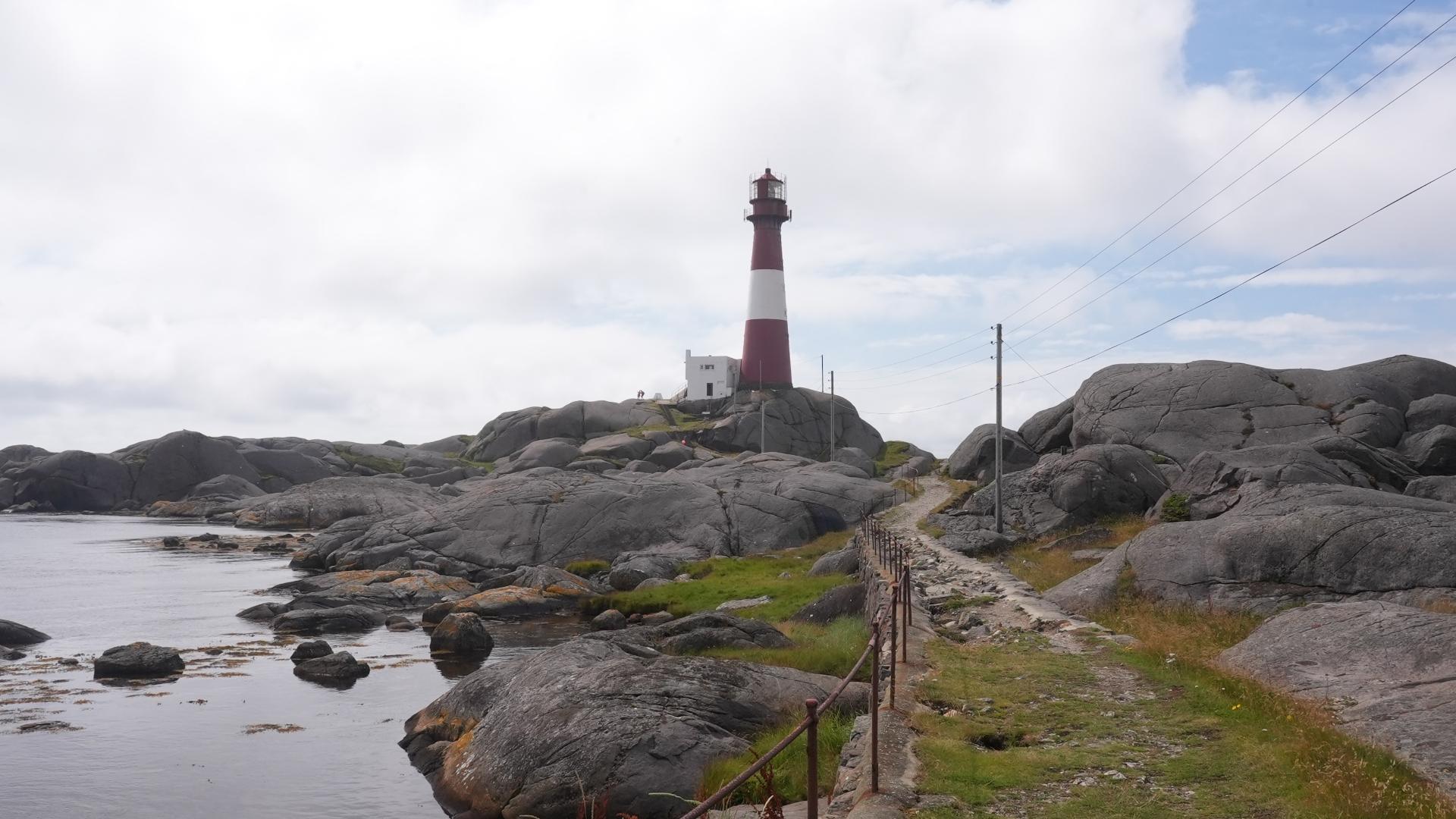
Built in 1873, Obrestad fyr was the first lighthouse along the Jæren coast built on land rather than on an island, and it remains the westernmost mainland lighthouse in Norway. The original 16.5-metre square granite tower with its keeper's residence was built to last, but the stone walls proved damp, cold, and miserable to live in; a wooden house was added in 1905. The lighthouse holds the only Fresnel lens with square rotating elements among Norwegian lighthouses, throwing a fixed flashing white beam visible for 18 nautical miles.
The tower you see today has a peculiar origin. During the German occupation, a lookout tower was built on top of the lighthouse in 1941 and bomb shelters constructed around the site. German soldiers painted murals in the basement that survive to this day. When the current tower was erected in 1949 to 1950, it was based on the design of that German wartime lookout. The lighthouse was automated in 1987 and the last keeper left in 1991. Its final full-time keeper, Idar Runde, served for 22 years and hand-built 43 Hawaiian guitars during his tenure, the first from an oak log washed ashore at Eigerøy lighthouse where he first worked. On pietistic Jæren, guitars were essential for religious music.
Hå municipality purchased the lighthouse in 2006. It now operates as a museum with permanent exhibitions about lighthouse life, a summer cafe, and year-round accommodation in the former keeper's houses. Protected under the Cultural Heritage Act since 2000.
The tower you see today has a peculiar origin. During the German occupation, a lookout tower was built on top of the lighthouse in 1941 and bomb shelters constructed around the site. German soldiers painted murals in the basement that survive to this day. When the current tower was erected in 1949 to 1950, it was based on the design of that German wartime lookout. The lighthouse was automated in 1987 and the last keeper left in 1991. Its final full-time keeper, Idar Runde, served for 22 years and hand-built 43 Hawaiian guitars during his tenure, the first from an oak log washed ashore at Eigerøy lighthouse where he first worked. On pietistic Jæren, guitars were essential for religious music.
Hå municipality purchased the lighthouse in 2006. It now operates as a museum with permanent exhibitions about lighthouse life, a summer cafe, and year-round accommodation in the former keeper's houses. Protected under the Cultural Heritage Act since 2000.