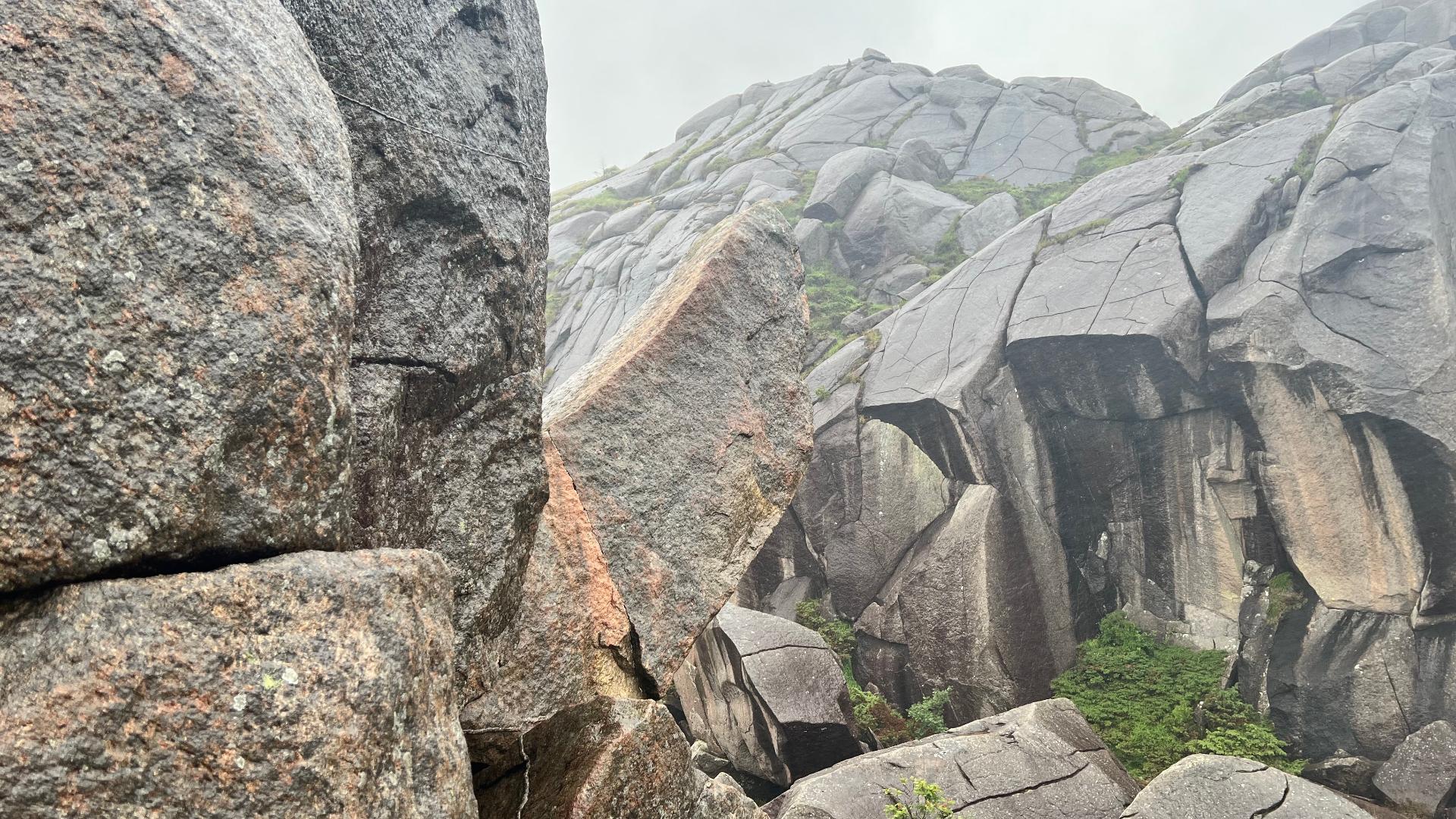
Described as Scandinavia's largest stone field, Gloppedalsura fills the narrow Gloppedalen valley with a 100-metre-thick deposit of angular, coarse boulders, some the size of houses. It formed roughly 10,000 years ago in two stages. First, retreating glaciers left an end moraine that dammed the valley, creating a lake at 240 metres above sea level. Then massive landslides from the steep southern cliffs sent enormous rock blocks crashing down on top of the moraine, triggered by frost shattering and weakness zones in the billion-year-old gneiss bedrock. The debris now forms the watershed between Gloppedalsvatnet to the northeast and Indra Vinjavatnet to the southwest. Part of Magma UNESCO Global Geopark.
On 22 April 1940, the boulders became a natural fortress. After the German invasion, 250 Norwegian soldiers retreated to Gloppedalsura and used the massive rocks as cover against two German battalions, roughly 800 soldiers, attacking from Veen at 09:19. The Germans attacked by ground and air throughout the day. At seven in the evening a major German assault brought soldiers within 25 metres of Norwegian positions. Germans eventually managed to sneak down the mountainside at night, forcing the Norwegians to withdraw to Byrkjedal. One Norwegian soldier, Georg Pettersen from Oslo, was killed. A memorial plaque on the road through the scree commemorates the battle.
A via ferrata climbing route opened in 2023 takes visitors through and between the boulders with fixed safety lines, suitable for children aged ten and up. The road through the scree, Fylkesveg 503 between Byrkjedal and Vikeså, passes partly through a tunnel. Byrkjedalstunet hotel and restaurant is a few minutes' drive away.
On 22 April 1940, the boulders became a natural fortress. After the German invasion, 250 Norwegian soldiers retreated to Gloppedalsura and used the massive rocks as cover against two German battalions, roughly 800 soldiers, attacking from Veen at 09:19. The Germans attacked by ground and air throughout the day. At seven in the evening a major German assault brought soldiers within 25 metres of Norwegian positions. Germans eventually managed to sneak down the mountainside at night, forcing the Norwegians to withdraw to Byrkjedal. One Norwegian soldier, Georg Pettersen from Oslo, was killed. A memorial plaque on the road through the scree commemorates the battle.
A via ferrata climbing route opened in 2023 takes visitors through and between the boulders with fixed safety lines, suitable for children aged ten and up. The road through the scree, Fylkesveg 503 between Byrkjedal and Vikeså, passes partly through a tunnel. Byrkjedalstunet hotel and restaurant is a few minutes' drive away.