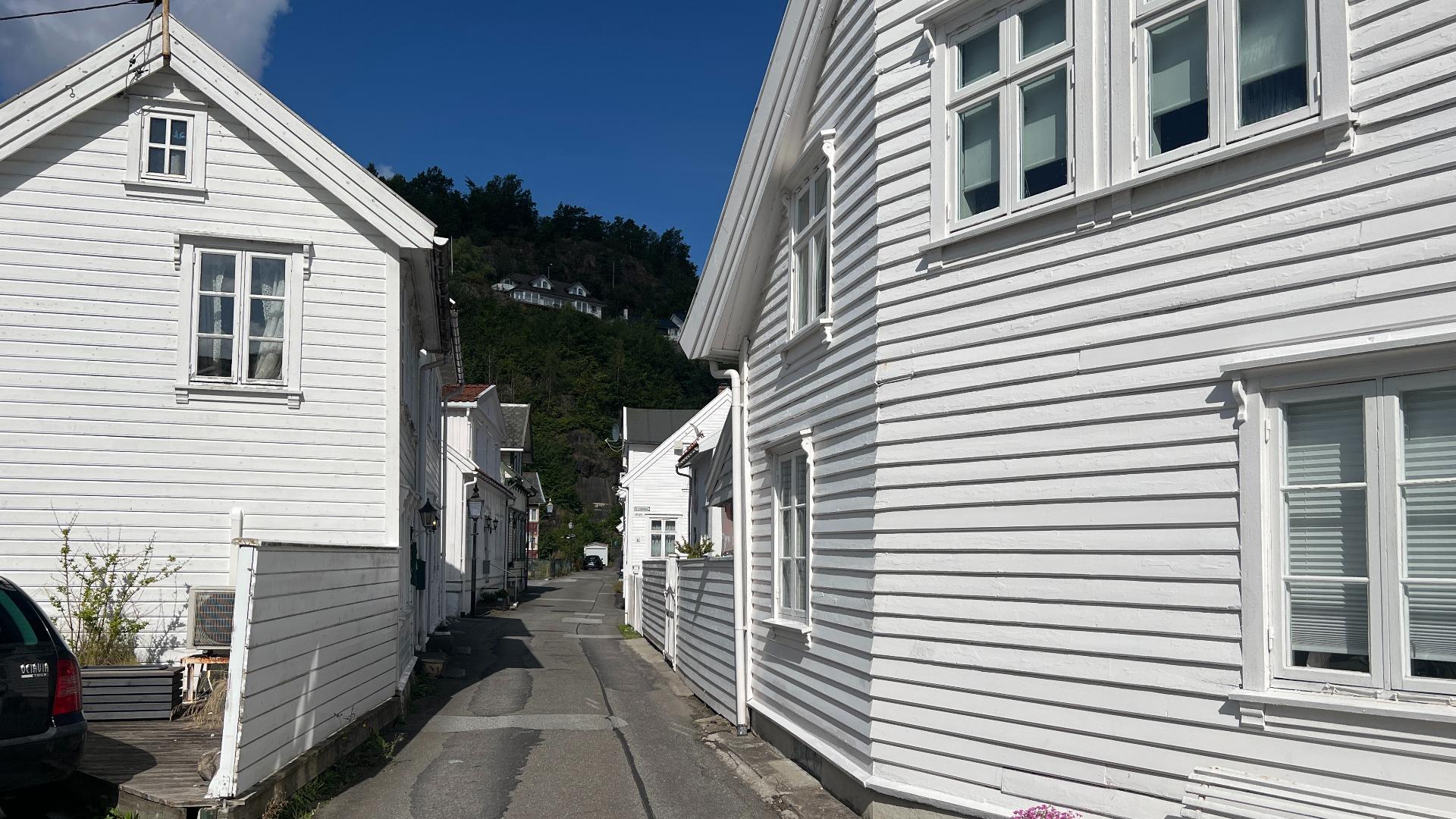
Flekkefjord earned its town privileges as a ladested in 1660, but by then, Dutch traders had been coming here for well over a century. Timber went to Amsterdam for construction, and paving stones from the harbour ended up on Dutch streets: in 1736 alone, over 300 ships carried stone from Flekkefjord. The northern end of town, known as Hollenderbyen, is where Dutch fishermen and merchants settled, and it survives today as a beautifully preserved quarter of white wooden houses along narrow streets. The Flekkefjord Museum, housed in one of these old merchant buildings, tells the story of the trade that shaped the town.
What really drove the economy, though, was herring. By the 1750s, Flekkefjord was one of the most important herring export harbours in Norway. Salted herring shipped from here fed much of northern Europe. Then, almost overnight, the herring vanished. By 1838, the great shoals had moved or collapsed entirely, and the town was left in economic freefall. The population shrank, businesses closed, and Flekkefjord might have disappeared entirely if it had not reinvented itself. The answer came from animal hides: a tanning industry grew rapidly through the mid-1800s, and by 1866 five tanneries were operating, making leather goods a new economic backbone. The shift from herring to hides is a pattern repeated along the Norwegian coast, but few towns illustrate the drama of it as clearly as this one.
Today Flekkefjord sits quietly at the junction of fjord, river, and sea. It is the starting point for the Flekkefjordbanen draisine ride along an old railway line through tunnels and along the waterfront, and a gateway to the Magma Geopark's lunar landscapes further inland. The combination of Dutch trade history, a boom-and-bust herring saga, and easy access to geological attractions makes it one of the more rewarding stops in the Dalane region.
What really drove the economy, though, was herring. By the 1750s, Flekkefjord was one of the most important herring export harbours in Norway. Salted herring shipped from here fed much of northern Europe. Then, almost overnight, the herring vanished. By 1838, the great shoals had moved or collapsed entirely, and the town was left in economic freefall. The population shrank, businesses closed, and Flekkefjord might have disappeared entirely if it had not reinvented itself. The answer came from animal hides: a tanning industry grew rapidly through the mid-1800s, and by 1866 five tanneries were operating, making leather goods a new economic backbone. The shift from herring to hides is a pattern repeated along the Norwegian coast, but few towns illustrate the drama of it as clearly as this one.
Today Flekkefjord sits quietly at the junction of fjord, river, and sea. It is the starting point for the Flekkefjordbanen draisine ride along an old railway line through tunnels and along the waterfront, and a gateway to the Magma Geopark's lunar landscapes further inland. The combination of Dutch trade history, a boom-and-bust herring saga, and easy access to geological attractions makes it one of the more rewarding stops in the Dalane region.