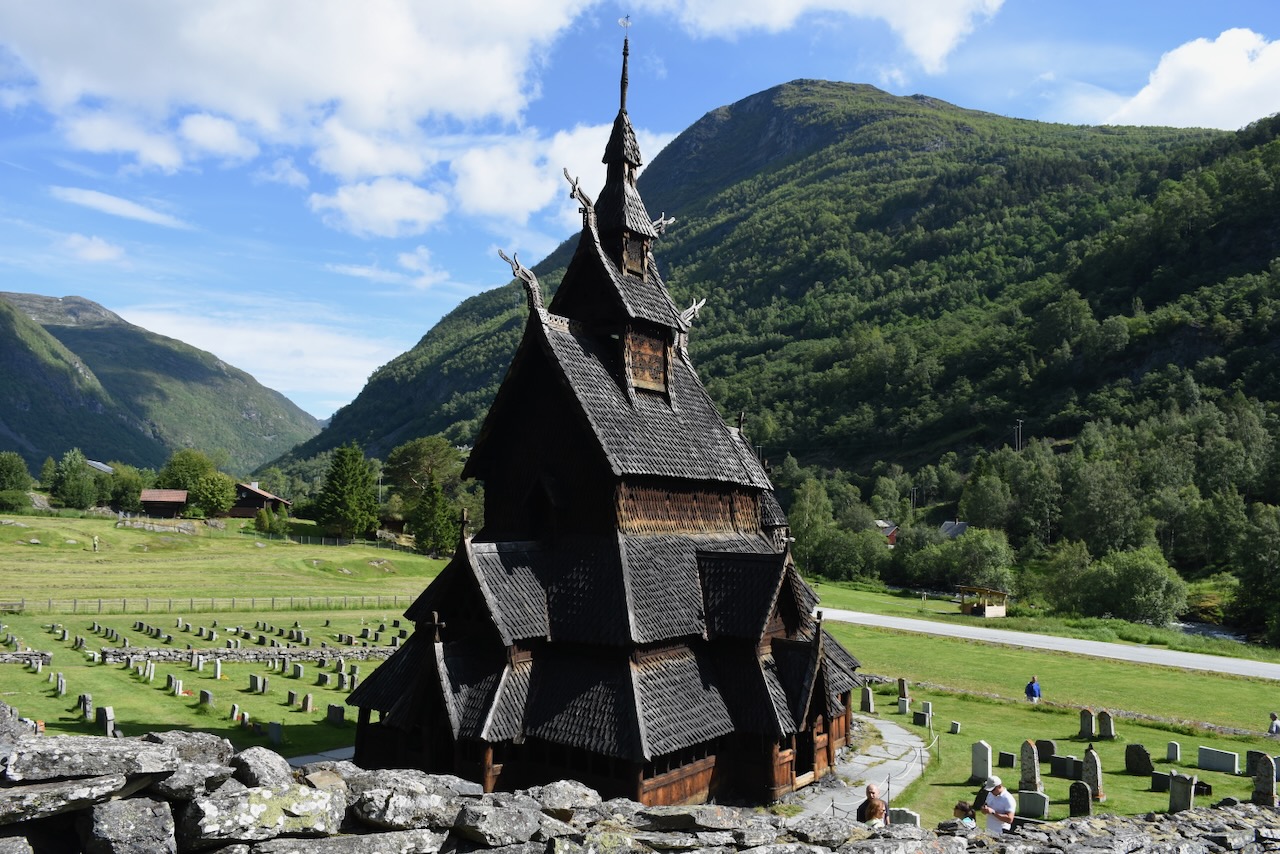
Borgund Stave Chruch is Norway's best-preserved stave church and one of the country's most important historical monuments. Built around 1180, it has stood here for over 800 years with remarkably few changes.
To understand what you're looking at, you need some context. During the Middle Ages, perhaps 1,000 to 2,000 stave churches were built across Norway. Today only 28 survive. Most were demolished to make way for larger churches, or simply fell into decay. Borgund escaped this fate partly because the community was too poor to replace it, and partly because the Society for the Preservation of Ancient Norwegian Monuments bought it in 1877 - just nine years after a new church was built next door.
The name comes from the construction method. Vertical wooden posts called "staver" form the load-bearing structure - the same technique Vikings used to build ships. If you look at the ceiling inside, you'll notice it resembles an upside-down boat hull. The builders knew wood, and they knew how to make it last.
What makes Borgund exceptional is how much original material remains. The tiered roofs, the carved dragon heads on the gables, the intricate portals - most date from the original construction. Those dragon heads are borrowed directly from Norse ship design. Their purpose is disputed among scholars, but one popular theory is that medieval builders were hedging their bets: officially Christian, but keeping the old protective symbols just in case the new god wasn't enough. You'll find similar ambiguity inside, where one runic inscription reads "Ave Maria" while another, written by a man named Þórir, blames the pagan Norns - the Norse fate goddesses - for his troubles. Covering all spiritual bases, it seems.
The exterior is blackened with tar, applied regularly to protect the wood. The south side needs recoating more often than the north, as it takes more punishment from the sun. On warm days, be careful - the tar can drip onto your clothes.
Inside, the space is surprisingly small and dark. Don't expect a cathedral - it's perhaps 40 square metres. There's no artificial lighting and flash photography is forbidden. Your eyes will need time to adjust. If you want to see details like the runic inscriptions, ask one of the staff to use their torch - they're usually happy to help.
Next to the church stands Norway's only surviving free-standing stave bell tower, probably built in the mid-13th century.
A few practical things. The ticket covers everything - church, exhibition, café, and toilets. You cannot access any of these separately. Large tour groups should contact the church in advance, as only 20 people are allowed inside at once and unannounced groups may be turned away. Dogs are not allowed inside the church, though they're welcome in the visitor centre. The interior can only be visited during summer season. No drone flying around the church.
If you find the church romantic and want to get married there, you'll need strong local ties - either you're from the area, or the community considers you one of them. Having lived there for several years and speaking the local dialect would help your case.