Vigelandsparken is the world's largest sculpture park made by a single artist, and Norway's most visited attraction, drawing between one and two million visitors a year. It is open around the clock and free to enter. The locals rarely call it Vigelandsparken; to them it is simply Frognerparken, the larger park that surrounds it.
The story begins with a housing dispute. In 1921, the City of Oslo decided to demolish the building where the sculptor Gustav Vigeland lived and worked, to make room for a library. After a drawn-out fight, the city offered him a deal: a brand new studio and apartment on Nobels gate, in exchange for every artwork he would create for the rest of his life. Vigeland accepted. He moved in during 1924 and immediately began designing an enormous sculpture installation for Frogner Park. He worked on it obsessively until his death in 1943. The installation was mostly completed by 1949, but it represents over forty years of creative work.
The park contains 212 sculptures in bronze, granite, and wrought iron, with over 600 individual figures. They are arranged along an 850-metre axis that runs from the main gate through the Bridge, past the Fountain, up to the Monolith plateau, and ends at the Wheel of Life.
The Bridge is lined with 58 bronze figures, sculpted between 1925 and 1933. They show human beings in every stage of life and every kind of emotion: fighting, embracing, playing, grieving. The most photographed is Sinnataggen, the Angry Boy, a small child mid-tantrum with clenched fists. He has been rubbed so often by visitors that his left hand is polished gold.
Beyond the Bridge lies the Fountain. Vigeland originally designed it for Eidsvolls plass in front of the Parliament, but those plans fell through, and the fountain became part of the park instead. Six giant bronze men strain under the weight of a massive basin from which water cascades. Around the pool stand twenty bronze trees, each intertwined with human figures from infancy to death: water giving life, the tree of life, the cycle from beginning to end. The floor around the fountain is a labyrinth of black and white granite, one of the largest mosaics in Scandinavia.
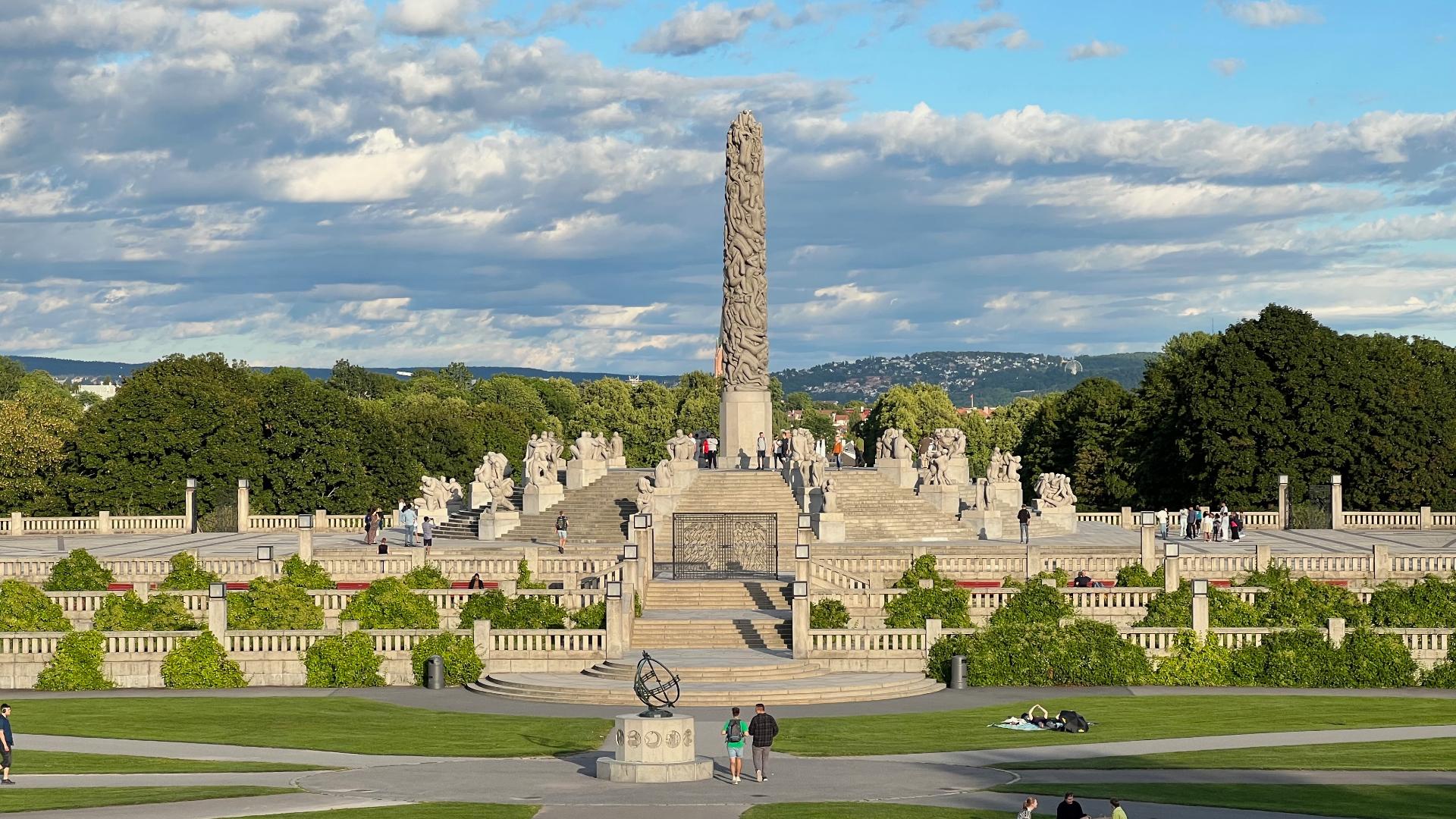
The centrepiece of the park is the Monolith, a single column of granite standing over 17 metres tall, carved with 121 intertwined human figures struggling upward. It is here that the distinction between Vigeland the artist and the men who built his vision matters most. Vigeland created all the designs as full-scale plaster models. He never carved the granite himself. The enormous block was blasted from a quarry near Hov in Iddefjorden on 4 April 1922. It was floated on two barges to Oslo, then hauled through the city streets at an average speed of six metres per hour, a journey that lasted from September 1926 to February 1927. Three stonemasons then spent fourteen years transferring Vigeland's plaster design onto the stone: the Dane Karl Kjær, the Swede Nils Jönsson, and the Norwegian Ivar Broe. They finished in 1943, the same year Vigeland died. He never saw the completed Monolith unveiled to the public.
The park's wrought iron entrance gates are worth a look on the way in. The lower half features dragon-like figures drawn from Norse mythology, while the upper sections are in Art Deco style, reflecting the fashion of the 1930s when Vigeland completed them.
On warm summer days, Frognerparken fills with locals sunbathing, barbecuing, and playing. The sculpture installation is just one part of a much larger green space. If you want the park to yourself, come early in the morning or after dark, when the sculptures are lit and the crowds are gone.
The story begins with a housing dispute. In 1921, the City of Oslo decided to demolish the building where the sculptor Gustav Vigeland lived and worked, to make room for a library. After a drawn-out fight, the city offered him a deal: a brand new studio and apartment on Nobels gate, in exchange for every artwork he would create for the rest of his life. Vigeland accepted. He moved in during 1924 and immediately began designing an enormous sculpture installation for Frogner Park. He worked on it obsessively until his death in 1943. The installation was mostly completed by 1949, but it represents over forty years of creative work.
The park contains 212 sculptures in bronze, granite, and wrought iron, with over 600 individual figures. They are arranged along an 850-metre axis that runs from the main gate through the Bridge, past the Fountain, up to the Monolith plateau, and ends at the Wheel of Life.
The Bridge is lined with 58 bronze figures, sculpted between 1925 and 1933. They show human beings in every stage of life and every kind of emotion: fighting, embracing, playing, grieving. The most photographed is Sinnataggen, the Angry Boy, a small child mid-tantrum with clenched fists. He has been rubbed so often by visitors that his left hand is polished gold.
Beyond the Bridge lies the Fountain. Vigeland originally designed it for Eidsvolls plass in front of the Parliament, but those plans fell through, and the fountain became part of the park instead. Six giant bronze men strain under the weight of a massive basin from which water cascades. Around the pool stand twenty bronze trees, each intertwined with human figures from infancy to death: water giving life, the tree of life, the cycle from beginning to end. The floor around the fountain is a labyrinth of black and white granite, one of the largest mosaics in Scandinavia.
The centrepiece of the park is the Monolith, a single column of granite standing over 17 metres tall, carved with 121 intertwined human figures struggling upward. It is here that the distinction between Vigeland the artist and the men who built his vision matters most. Vigeland created all the designs as full-scale plaster models. He never carved the granite himself. The enormous block was blasted from a quarry near Hov in Iddefjorden on 4 April 1922. It was floated on two barges to Oslo, then hauled through the city streets at an average speed of six metres per hour, a journey that lasted from September 1926 to February 1927. Three stonemasons then spent fourteen years transferring Vigeland's plaster design onto the stone: the Dane Karl Kjær, the Swede Nils Jönsson, and the Norwegian Ivar Broe. They finished in 1943, the same year Vigeland died. He never saw the completed Monolith unveiled to the public.
The park's wrought iron entrance gates are worth a look on the way in. The lower half features dragon-like figures drawn from Norse mythology, while the upper sections are in Art Deco style, reflecting the fashion of the 1930s when Vigeland completed them.
On warm summer days, Frognerparken fills with locals sunbathing, barbecuing, and playing. The sculpture installation is just one part of a much larger green space. If you want the park to yourself, come early in the morning or after dark, when the sculptures are lit and the crowds are gone.