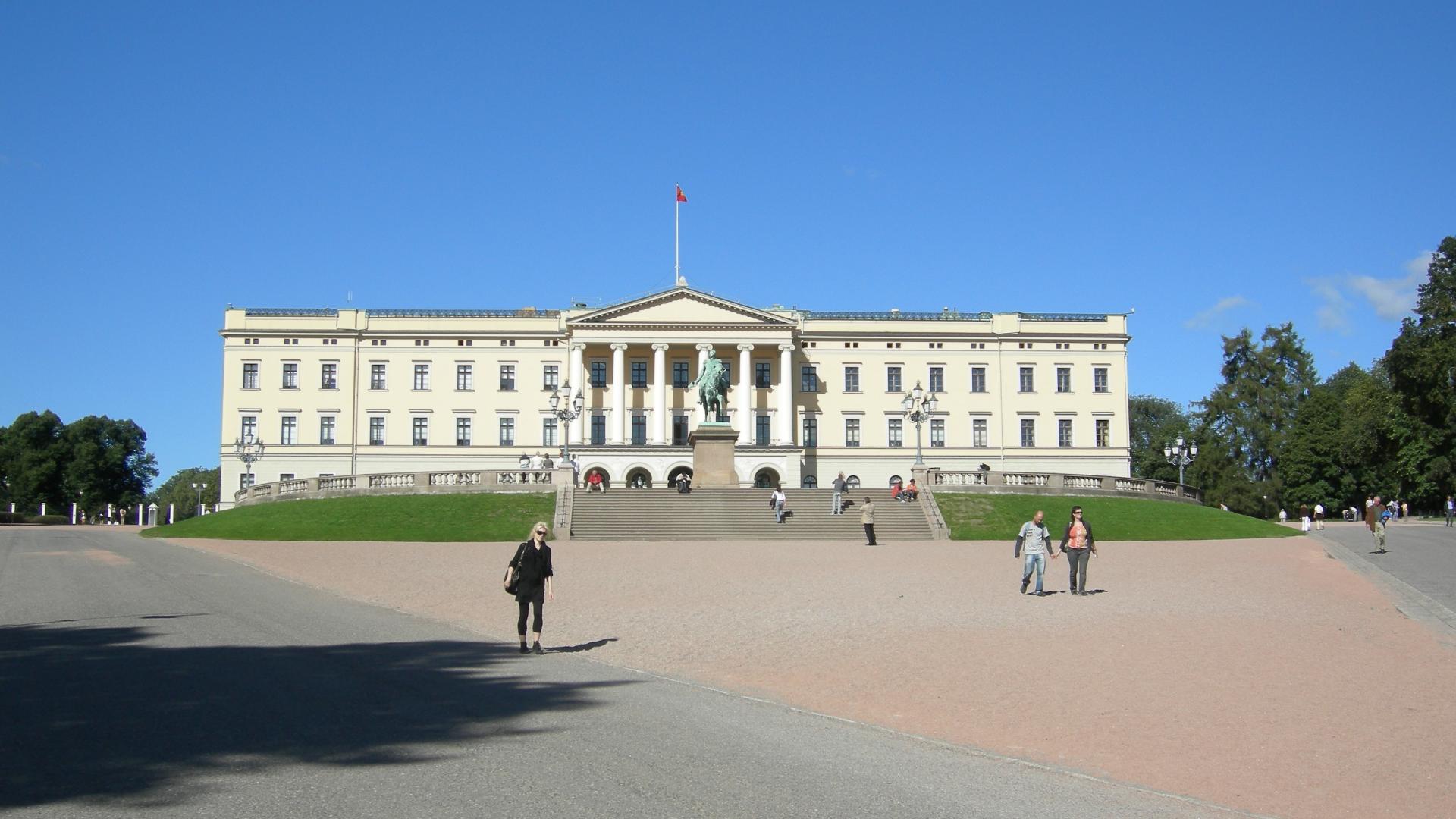
At the top of Karl Johans gate, on a hill that was once open countryside west of the city, stands the Royal Palace, the official residence of the Norwegian monarch. The story of how it got there is a slow one. In 1822, King Karl Johan proposed building a royal residence in Christiania. The site was chosen during a horseback ride: the king liked the view from Bellevuehøyden, the hill that is now Slottsparken. The Danish-born architect Hans Ditlev Franciscus Linstow was commissioned to design the building, and the king laid the foundation stone on 1 October 1825.
Then the money ran out. By 1827, the foundations were complete but the budget was spent, and the Storting refused to allocate more funds. Construction stopped entirely for six years. Linstow's original plan called for an H-shaped building, but this was scaled down to a simpler U shape to save money. Work eventually resumed in 1833, and the palace was finally completed and inaugurated on 26 July 1849, four years after Karl Johan himself had died. The king never lived in his own palace.
The building is a relatively modest affair by European royal standards, built in the neoclassical style with a temple front of columns on the main facade. It has 173 rooms. Unlike most royal residences in Europe, there is no fence or wall around it. Visitors can walk right up to the building, which gives the palace an unusually approachable feel. There are guards, of course, but most of them are young people doing their military service, and they are noticeably less rigid than, say, the guards at Buckingham Palace.
Every day at 13:30 there is the changing of the guard ceremony, which is free to watch. On most days it is a fairly brief affair lasting around fifteen minutes, but during summer the ceremony can include a full parade with a military band marching up from Akershus Festning via Karl Johans gate, arriving at the palace square around 13:30. Those parades can last up to forty minutes.
It is possible to visit the inside of the palace during summer, roughly from late June to mid August. Guided tours take visitors through the state rooms, the banquet hall and the royal chapel. Tours are very popular and often sell out, so booking in advance is recommended. In front of the palace stands a large equestrian statue of King Karl Johan. Around the building is Slottsparken, a large public park open to everyone, and behind the palace you will find Dronning Sonjas Kunststall, the Queen's art stable, reflecting Queen Sonja's well-known passion for modern art.
Then the money ran out. By 1827, the foundations were complete but the budget was spent, and the Storting refused to allocate more funds. Construction stopped entirely for six years. Linstow's original plan called for an H-shaped building, but this was scaled down to a simpler U shape to save money. Work eventually resumed in 1833, and the palace was finally completed and inaugurated on 26 July 1849, four years after Karl Johan himself had died. The king never lived in his own palace.
The building is a relatively modest affair by European royal standards, built in the neoclassical style with a temple front of columns on the main facade. It has 173 rooms. Unlike most royal residences in Europe, there is no fence or wall around it. Visitors can walk right up to the building, which gives the palace an unusually approachable feel. There are guards, of course, but most of them are young people doing their military service, and they are noticeably less rigid than, say, the guards at Buckingham Palace.
Every day at 13:30 there is the changing of the guard ceremony, which is free to watch. On most days it is a fairly brief affair lasting around fifteen minutes, but during summer the ceremony can include a full parade with a military band marching up from Akershus Festning via Karl Johans gate, arriving at the palace square around 13:30. Those parades can last up to forty minutes.
It is possible to visit the inside of the palace during summer, roughly from late June to mid August. Guided tours take visitors through the state rooms, the banquet hall and the royal chapel. Tours are very popular and often sell out, so booking in advance is recommended. In front of the palace stands a large equestrian statue of King Karl Johan. Around the building is Slottsparken, a large public park open to everyone, and behind the palace you will find Dronning Sonjas Kunststall, the Queen's art stable, reflecting Queen Sonja's well-known passion for modern art.