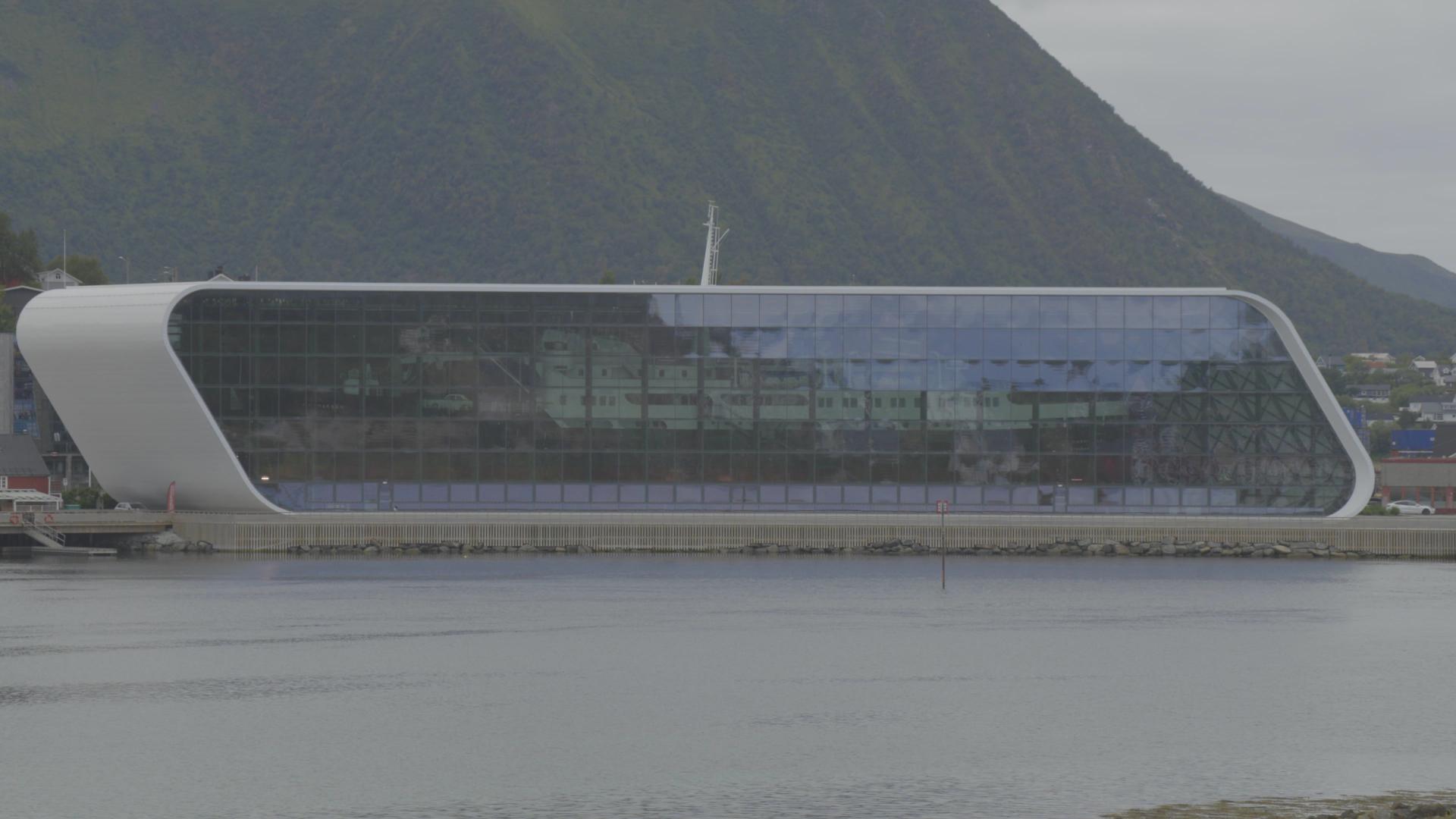
Most museums display cars, trains, or boats. This one has a real ocean-going ship inside a building. M/S Finnmarken from 1956, the second ship on the Hurtigruten to bear that name, is the centrepiece of the Hurtigrutemuseet in Stokmarknes. It is the largest museum artefact to be housed inside a building anywhere in the world. Larger museum ships exist, like battleships and aircraft carriers, but they sit outdoors.
The ship was decommissioned and brought ashore in 1993. Plans to build a shelter dragged on for decades. Construction finally began in 2019 and was finished in 2021, costing 120 million kroner. With the ship on land, you can see it from angles that would normally be impossible. The propeller and rudder are visible up close, and even on a small ship they are impressively large.
Around the ship, themed stations cover the history of the Hurtigrute. The inside of the ship can also be visited: passenger quarters with hostel-level comfort (cabins had no private bathroom), crew quarters, cargo deck, bridge, and restaurant. The restaurant doubles as the museum restaurant and serves typical dishes you would find on a ferry. The engine room can only be visited on a guided tour, where you see the massive engine and drive shaft.
It is worth noting that this museum is not related to the company Hurtigruten AS. Over the 130-year history of the route, many different shipping companies operated it. The first was Vesteraalens Dampskibsselskab, founded here in Stokmarknes in 1893. A section of the original DS Finmarken from 1912 is also on display. The remains were found in the Netherlands and brought back for restoration.
As a side note, the sister ship M/S Nordstjernen is still in passenger service on expedition cruises with the same level of comfort. M/S Lofoten, a ship from the same period, was in actual service on the Hurtigruten until March 2020.
The museum is next to the Hurtigruten port in Stokmarknes. Passengers on the southbound ship can visit. The northbound ship passes in the middle of the night. The museum is open every day, all year round. Plan two hours for the visit.
The ship was decommissioned and brought ashore in 1993. Plans to build a shelter dragged on for decades. Construction finally began in 2019 and was finished in 2021, costing 120 million kroner. With the ship on land, you can see it from angles that would normally be impossible. The propeller and rudder are visible up close, and even on a small ship they are impressively large.
Around the ship, themed stations cover the history of the Hurtigrute. The inside of the ship can also be visited: passenger quarters with hostel-level comfort (cabins had no private bathroom), crew quarters, cargo deck, bridge, and restaurant. The restaurant doubles as the museum restaurant and serves typical dishes you would find on a ferry. The engine room can only be visited on a guided tour, where you see the massive engine and drive shaft.
It is worth noting that this museum is not related to the company Hurtigruten AS. Over the 130-year history of the route, many different shipping companies operated it. The first was Vesteraalens Dampskibsselskab, founded here in Stokmarknes in 1893. A section of the original DS Finmarken from 1912 is also on display. The remains were found in the Netherlands and brought back for restoration.
As a side note, the sister ship M/S Nordstjernen is still in passenger service on expedition cruises with the same level of comfort. M/S Lofoten, a ship from the same period, was in actual service on the Hurtigruten until March 2020.
The museum is next to the Hurtigruten port in Stokmarknes. Passengers on the southbound ship can visit. The northbound ship passes in the middle of the night. The museum is open every day, all year round. Plan two hours for the visit.