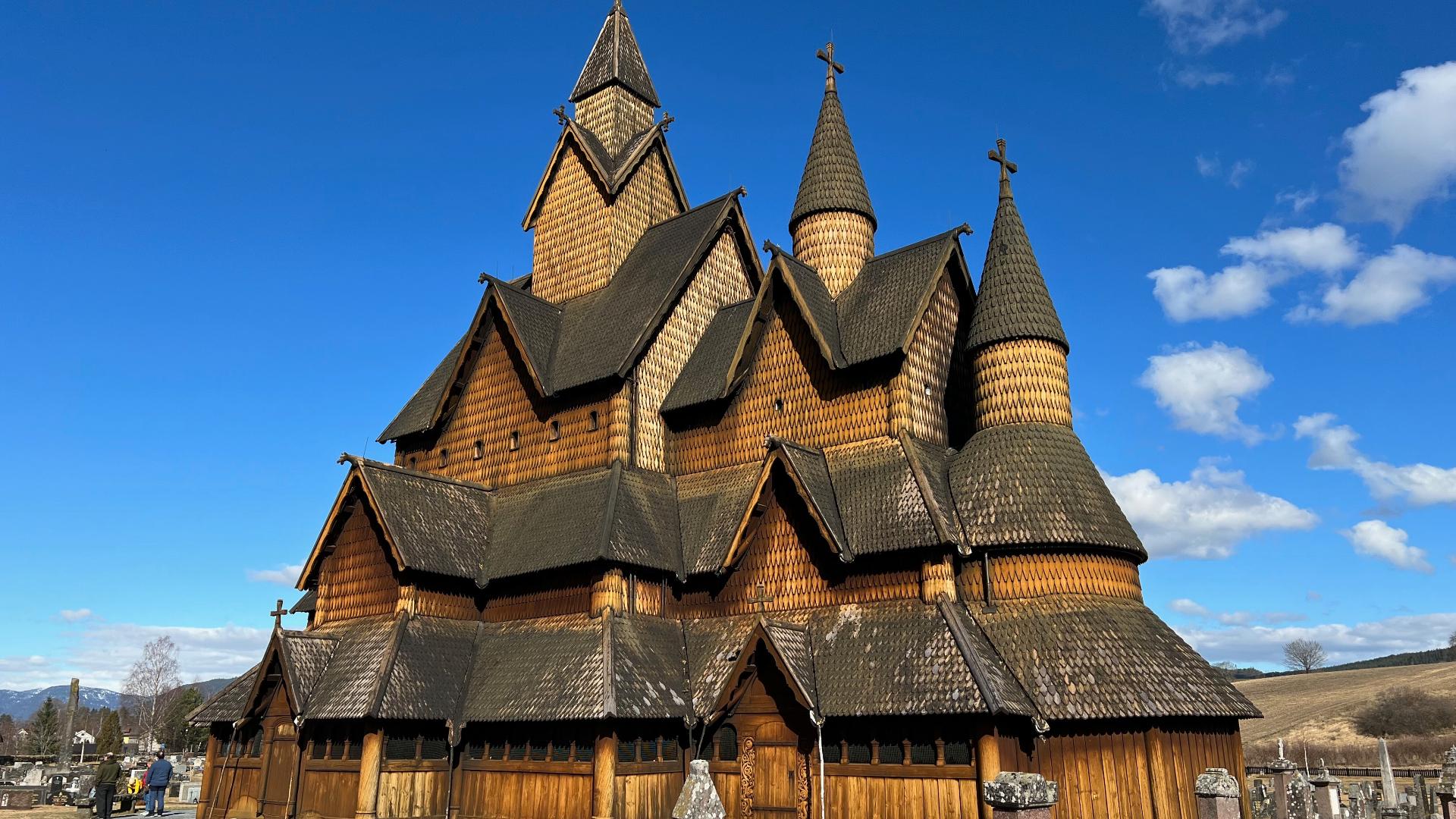
Heddal is the largest surviving stave church in Norway. It stands 29 metres tall with three distinctive towers and from a distance looks like a wooden cathedral rising from the fields. It was built around the year 1200, though some of the timber dates back to around the year 1000, likely reused from an earlier building on the same site.
The construction method is the same as Viking shipbuilding. No nails, just expertly crafted joints. Twelve large pine staves and six smaller ones support the structure. The whole building is coated in wood tar, which gives it the dark, almost black appearance and that distinctive smell. Around the four entrance portals you will find intricate carvings of dragons, snakes, and intertwined vines. Roughly forty dragon figures guard the main entrance alone. On top of the 23 internal pillars are carved mask faces. Nobody knows what purpose they served, but they may represent ancestors or protective spirits from the old faith.
Inside, the medieval furniture tells the story of Sigurd the Dragon Slayer, the same Norse legend that inspired Wagner's Ring cycle and Tolkien's books. The bishop's chair from the 1250s shows Sigurd, Brunhilde, and her suitors. Two other pieces were taken to a museum in Oslo in 1882, but replicas were made in 2018-19 using the same tools and techniques as the medieval craftsmen.
The church has a complicated preservation history. By the mid-1800s it was in serious disrepair. The architect who restored it transformed the interior into fashionable Empire style, completely wrong for a medieval building. He added windows and modernised everything. It was heavily criticised even at the time, and worse, the changes caused moisture damage and fungal growth. A century later, in the 1950s, they undid most of those changes and tried to restore it to look medieval again. Then in 2008 they discovered original wall paintings that had been painted over in the 17th century. So what you see today is a 1950s reconstruction of what they believed a medieval church should look like, with some genuinely medieval elements recently uncovered.
The church is still in active use. Weddings, baptisms, confirmations, and services are held during summer. It may be closed on weekends for ceremonies. In winter the congregation uses the Låvekirken, a barn converted into a church in 1993, because the old timber does not respond well to temperature changes. You can visit the inside from May to September. Next to the church is Heddal Bygdetun, an open-air museum with old farm buildings. Plan 30 minutes to an hour.
The construction method is the same as Viking shipbuilding. No nails, just expertly crafted joints. Twelve large pine staves and six smaller ones support the structure. The whole building is coated in wood tar, which gives it the dark, almost black appearance and that distinctive smell. Around the four entrance portals you will find intricate carvings of dragons, snakes, and intertwined vines. Roughly forty dragon figures guard the main entrance alone. On top of the 23 internal pillars are carved mask faces. Nobody knows what purpose they served, but they may represent ancestors or protective spirits from the old faith.
Inside, the medieval furniture tells the story of Sigurd the Dragon Slayer, the same Norse legend that inspired Wagner's Ring cycle and Tolkien's books. The bishop's chair from the 1250s shows Sigurd, Brunhilde, and her suitors. Two other pieces were taken to a museum in Oslo in 1882, but replicas were made in 2018-19 using the same tools and techniques as the medieval craftsmen.
The church has a complicated preservation history. By the mid-1800s it was in serious disrepair. The architect who restored it transformed the interior into fashionable Empire style, completely wrong for a medieval building. He added windows and modernised everything. It was heavily criticised even at the time, and worse, the changes caused moisture damage and fungal growth. A century later, in the 1950s, they undid most of those changes and tried to restore it to look medieval again. Then in 2008 they discovered original wall paintings that had been painted over in the 17th century. So what you see today is a 1950s reconstruction of what they believed a medieval church should look like, with some genuinely medieval elements recently uncovered.
The church is still in active use. Weddings, baptisms, confirmations, and services are held during summer. It may be closed on weekends for ceremonies. In winter the congregation uses the Låvekirken, a barn converted into a church in 1993, because the old timber does not respond well to temperature changes. You can visit the inside from May to September. Next to the church is Heddal Bygdetun, an open-air museum with old farm buildings. Plan 30 minutes to an hour.