Deichman Bjørvika is the main building of Oslo's public library system, and it is far more than just a place to borrow books. The library is named after Carl Deichman, a wealthy businessman who upon his death in 1780 bequeathed his private collection of over 6,000 volumes and 150 manuscripts to the city of Christiania. The library opened to the public on 12 January 1785, making it Norway's oldest public library.
For most of its history, the main branch was housed in various buildings around the city. The current building in Bjørvika, designed by the Norwegian firms Lund Hagem and Atelier Oslo who won an international competition in 2009, was supposed to be a straightforward prestige project. It turned into anything but. The building site on the muddy harbour shore proved treacherous: water kept pouring into the foundation pit, causing massive delays and cost overruns. The planned underground cinema had to be scrapped entirely because the cellar could not be made watertight. When the city council approved the project in 2013, the budget was 2.6 billion kroner with an expected opening in September 2016. By 2015, an external review estimated the final cost at over 3.1 billion kroner, and the opening was pushed back by three years. The city government at one point threatened to cancel the entire project. Budget overruns, water leaks, construction delays, and public criticism of the facade design dogged the project throughout.
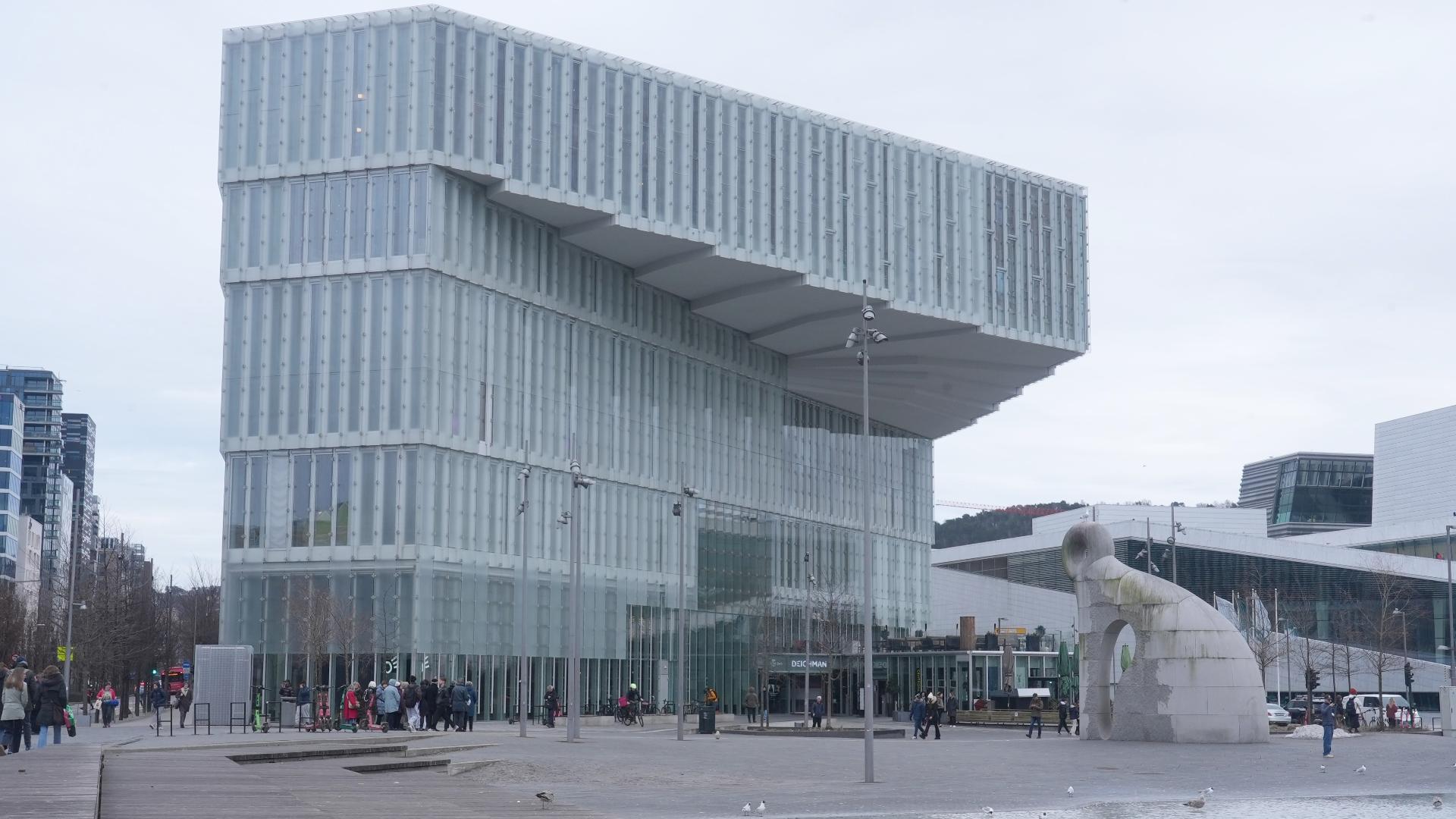
The library finally opened on 18 June 2020, in the middle of a pandemic. Whatever one thinks of the process, the result is impressive. The five-storey building wraps around a large, top-lit atrium that connects the floors and breaks them into smaller, intimate spaces. It has room for 450,000 books. Beyond the collection, there are media workshops, a gaming area, play spaces for children, quiet reading lounges and a cafe on the ground floor. The library has won several international awards, including the IFLA Public Library of the Year prize. It is open nearly every day and entry is completely free.
For visitors to Oslo, Deichman is worth a quick stop even if you have no intention of reading anything. The architecture alone is striking, the views from the upper floors are good, and it is a welcome place to sit down and rest between sightseeing stops, especially on rainy days.
For most of its history, the main branch was housed in various buildings around the city. The current building in Bjørvika, designed by the Norwegian firms Lund Hagem and Atelier Oslo who won an international competition in 2009, was supposed to be a straightforward prestige project. It turned into anything but. The building site on the muddy harbour shore proved treacherous: water kept pouring into the foundation pit, causing massive delays and cost overruns. The planned underground cinema had to be scrapped entirely because the cellar could not be made watertight. When the city council approved the project in 2013, the budget was 2.6 billion kroner with an expected opening in September 2016. By 2015, an external review estimated the final cost at over 3.1 billion kroner, and the opening was pushed back by three years. The city government at one point threatened to cancel the entire project. Budget overruns, water leaks, construction delays, and public criticism of the facade design dogged the project throughout.
The library finally opened on 18 June 2020, in the middle of a pandemic. Whatever one thinks of the process, the result is impressive. The five-storey building wraps around a large, top-lit atrium that connects the floors and breaks them into smaller, intimate spaces. It has room for 450,000 books. Beyond the collection, there are media workshops, a gaming area, play spaces for children, quiet reading lounges and a cafe on the ground floor. The library has won several international awards, including the IFLA Public Library of the Year prize. It is open nearly every day and entry is completely free.
For visitors to Oslo, Deichman is worth a quick stop even if you have no intention of reading anything. The architecture alone is striking, the views from the upper floors are good, and it is a welcome place to sit down and rest between sightseeing stops, especially on rainy days.